
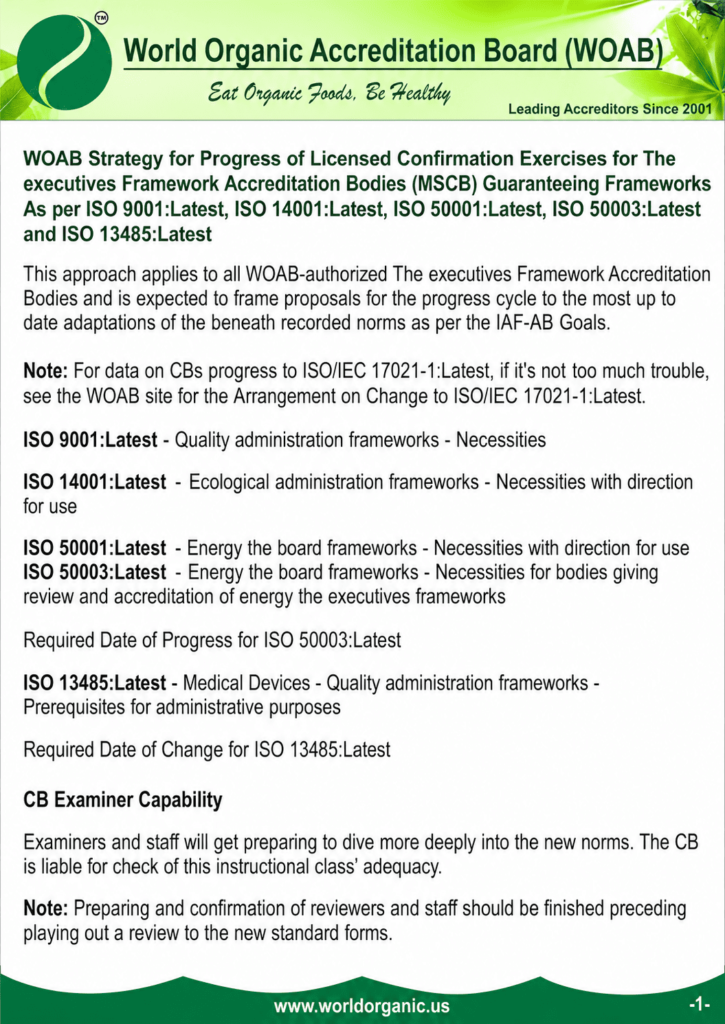
WOAB Policy for Transition of Management System Certification Body Accreditation
World Organic Accreditation Board (WOAB)
Document No.: WOAB-POL-TS-001
Version: 1.0
Effective Date: July 2026
Review Date: July 2029
Classification: Public Document
1. Introduction
The World Organic Accreditation Board (WOAB) is committed to maintaining the integrity, impartiality, and international recognition of accredited Management System Certification Bodies (MSCBs). As International Organization for Standardization (ISO) management system standards are revised periodically, accredited Certification Bodies (CBs) must ensure timely implementation of these revised standards while maintaining confidence in accredited certification.
This policy establishes the requirements and expectations for all WOAB-accredited Management System Certification Bodies during the transition from previous editions of management system standards to newly published editions.
The policy provides a structured framework for planning, implementing, monitoring, and completing transition activities while ensuring consistency with the requirements of ISO, ISO/CASCO documents, the International Accreditation Forum (IAF), and applicable regulatory requirements.
This document applies to accreditation activities relating to the following management system standards:
- ISO 9001 – Quality Management Systems
- ISO 14001 – Environmental Management Systems
- ISO 50001 – Energy Management Systems
- ISO 50003 – Requirements for bodies providing audit and certification of energy management systems
- ISO 13485 – Medical Devices – Quality Management Systems
- ISO/IEC 17021-1 – Conformity Assessment – Requirements for Bodies Providing Audit and Certification of Management Systems
Whenever a revised edition of any of these standards is published, WOAB will establish an official transition program specifying implementation timelines, accreditation activities, and certification requirements.
2. Purpose
The purpose of this policy is to:
- Ensure consistent implementation of revised ISO management system standards.
- Maintain the integrity and credibility of accredited certification.
- Establish uniform transition requirements for accredited Certification Bodies.
- Ensure competence of auditors during transition.
- Protect confidence of regulators, customers, certification holders, and other interested parties.
- Minimize disruption to certified organizations.
- Ensure international acceptance of accredited certificates.
This policy provides Certification Bodies with a structured approach for managing transition activities from publication of a revised standard until completion of all transition requirements.
3. Scope
This policy applies to:
- All WOAB-accredited Management System Certification Bodies.
- Applicant Certification Bodies undergoing accreditation.
- Certification activities performed under WOAB accreditation.
- Initial Certification Audits.
- Surveillance Audits.
- Recertification Audits.
- Special Audits conducted during transition.
- Remote and on-site audits.
- Witness assessments conducted by WOAB.
- Accreditation assessments performed by WOAB assessment teams.
The policy also applies to subcontracted audit activities performed under the responsibility of an accredited Certification Body.
4. Objectives
The objectives of this policy are to:
- Ensure orderly implementation of revised ISO standards.
- Promote consistent audit practices.
- Ensure competence of audit personnel.
- Protect accredited certification during transition.
- Reduce risks associated with inconsistent implementation.
- Provide confidence to certified organizations and interested parties.
- Maintain compliance with international accreditation requirements.
5. Normative References
The implementation of this policy shall consider the latest editions of applicable international standards and guidance documents, including but not limited to:
- ISO/IEC 17011 – Conformity Assessment – Requirements for Accreditation Bodies Accrediting Conformity Assessment Bodies
- ISO/IEC 17021-1 – Requirements for Bodies Providing Audit and Certification of Management Systems
- ISO 9001
- ISO 14001
- ISO 50001
- ISO 50003
- ISO 13485
- Applicable IAF Mandatory Documents
- Applicable ISO/CASCO Guidance Documents
- Relevant regulatory requirements where applicable
Whenever revised editions are published, WOAB will issue additional guidance as necessary.
6. Definitions
For the purposes of this document, the following definitions apply.
Accreditation
Third-party attestation by WOAB relating to a Certification Body conveying formal demonstration of its competence to carry out specified conformity assessment activities.
Certification Body (CB)
An organization accredited by WOAB to conduct management system certification audits and issue accredited certificates.
Certified Organization
An organization whose management system has been certified by an accredited Certification Body.
Transition
The process of moving from one edition of an ISO standard to another edition within the timeframe established by WOAB and applicable international requirements.
Transition Audit
An audit conducted for the purpose of evaluating conformity against a revised management system standard.
Surveillance Audit
A periodic audit conducted during the certification cycle to verify continued conformity.
Recertification Audit
A comprehensive audit conducted before expiration of certification to renew certification for another certification cycle.
Witness Assessment
Observation by WOAB of a Certification Body conducting an audit to evaluate auditor competence and conformity with accreditation requirements.
7. General Policy
WOAB requires all accredited Certification Bodies to establish documented procedures for implementing newly published ISO standards within the transition period announced by WOAB.
Certification Bodies shall:
- Establish documented transition plans.
- Train all personnel.
- Inform certified clients.
- Update audit documentation.
- Verify auditor competence.
- Complete transition activities before applicable deadlines.
- Maintain records of transition implementation.
No accredited certificate shall remain referenced to an obsolete edition of an ISO management system standard after the official transition deadline established by WOAB.
8. Principles of Transition
The transition process shall be based upon the following principles:
8.1 Impartiality
Transition activities shall be conducted without bias or conflict of interest.
8.2 Competence
Only qualified auditors competent in the revised standard shall perform transition audits.
8.3 Consistency
Transition decisions shall be applied consistently across all certified organizations.
8.4 Transparency
Certification Bodies shall provide clear information to clients regarding:
- Transition deadlines
- New requirements
- Audit duration
- Certification validity
- Additional audit activities
8.5 Risk-Based Approach
Transition planning shall consider:
- Complexity of client operations
- Industry sector
- Regulatory requirements
- Changes introduced by the revised standard
- Previous audit results
- Organizational risk
9. Responsibilities of WOAB
WOAB shall:
- Publish transition policies.
- Provide implementation guidance.
- Communicate official transition timelines.
- Evaluate Certification Body readiness.
- Conduct office assessments.
- Perform witness assessments.
- Review auditor competence.
- Verify updated certification procedures.
- Monitor implementation progress.
- Resolve transition-related technical questions.
- Maintain communication with accredited Certification Bodies.
WOAB may issue supplementary guidance where clarification of transition requirements becomes necessary.
10. Responsibilities of Accredited Certification Bodies
All Certification Bodies (CBs) accredited by the World Organic Accreditation Board (WOAB) shall establish, document, implement, maintain, and continually improve a structured transition program whenever a revised edition of an applicable management system standard is published.
The Certification Body shall ensure that all transition activities are completed within the transition period established by WOAB and any applicable international requirements.
The Certification Body shall designate a Transition Coordinator or other competent individual responsible for planning, monitoring, and reporting the implementation of transition activities throughout the organization.
At a minimum, the Certification Body shall:
- Develop a documented transition implementation plan.
- Review the changes introduced by the revised standard.
- Perform a gap analysis between the previous and revised editions.
- Identify affected certification schemes and certified organizations.
- Train auditors and technical personnel.
- Update internal procedures.
- Revise audit reports, checklists, forms, and certification documentation.
- Inform all certified clients of transition arrangements.
- Schedule transition audits.
- Monitor implementation progress.
- Maintain records demonstrating completion of all transition activities.
- Cooperate with WOAB during transition assessments.
The Certification Body shall ensure that sufficient personnel and resources are available to complete the transition within the established timeframe.
11. Transition Planning
Each accredited Certification Body shall prepare a documented Transition Plan approved by top management.
The Transition Plan shall include, as applicable:
- Scope of affected accreditation programs.
- Applicable ISO standards.
- Official transition deadlines.
- Responsibilities and authorities.
- Communication strategy.
- Auditor training schedule.
- Internal procedure revisions.
- Documentation update schedule.
- Client notification process.
- Transition audit scheduling.
- Monitoring activities.
- Internal review meetings.
- Risk assessment.
- Corrective action process.
- Progress reporting.
- Completion verification.
The Transition Plan shall be periodically reviewed to ensure implementation remains on schedule.
Any significant delays shall be documented together with corrective actions.
12. Gap Analysis
Before implementing a revised management system standard, the Certification Body shall perform a comprehensive gap analysis.
The purpose of the gap analysis is to identify:
- New clauses.
- Modified requirements.
- Deleted requirements.
- New terminology.
- Additional documentation needs.
- Auditor competence requirements.
- Client implementation impacts.
- Certification process changes.
The results of the gap analysis shall be documented and used when preparing training programs and revising certification procedures.
13. Auditor Competence
The competence of auditors is fundamental to maintaining confidence in accredited certification.
The Certification Body shall ensure that all auditors, technical experts, technical reviewers, certification decision-makers, and other personnel involved in certification activities are competent regarding the revised standard before participating in audits.
Competence shall include:
Knowledge of Standard Requirements
Personnel shall understand:
- Structure of the revised standard.
- New clauses.
- Revised terminology.
- Risk-based thinking.
- Process approach.
- Applicable regulatory requirements.
- Sector-specific requirements.
- Transition expectations.
Audit Skills
Auditors shall demonstrate competence in:
- Planning transition audits.
- Conducting effective interviews.
- Reviewing revised documentation.
- Evaluating implementation.
- Identifying conformity.
- Raising nonconformities.
- Reporting audit findings.
- Determining audit conclusions.
Technical Knowledge
Technical competence shall include:
- Industry processes.
- Applicable legislation.
- Relevant technologies.
- Customer-specific requirements.
- Certification scheme requirements.
14. Auditor Training
Before conducting any audit against a revised standard, every auditor shall successfully complete appropriate transition training.
Training programs should include:
Standard Interpretation
- Review of revised clauses.
- Comparison with previous editions.
- Intent of changes.
- Practical application.
- Interpretation guidance.
Audit Methodology
Training should cover:
- Audit planning.
- Audit execution.
- Sampling methods.
- Objective evidence.
- Audit reporting.
- Transition-specific requirements.
Practical Exercises
Training should include:
- Case studies.
- Group workshops.
- Simulated audits.
- Documentation review.
- Nonconformity writing.
- Corrective action evaluation.
Competence Evaluation
The Certification Body shall verify training effectiveness through one or more of the following:
- Written examinations.
- Practical assessments.
- Witnessed audits.
- Peer evaluation.
- Technical interviews.
- Observation during audits.
Records of competence evaluations shall be maintained.
No auditor shall perform transition audits until competence has been demonstrated.
15. Communication with Certified Clients
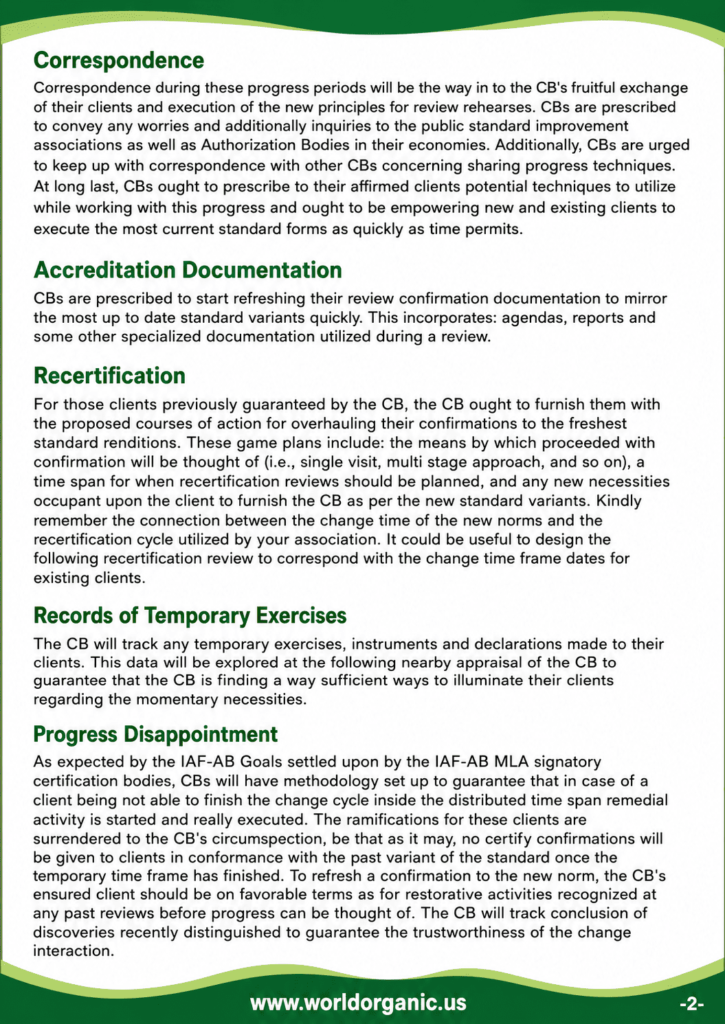
Effective communication is essential to successful implementation of revised standards.
Certification Bodies shall communicate with all certified organizations as early as practicable after publication of a revised standard.
Communications should explain:
- Publication of the revised standard.
- Official transition period.
- Expected implementation timeline.
- Client responsibilities.
- Audit arrangements.
- Certification validity.
- Required documentation updates.
- Changes to audit duration.
- Additional costs, if applicable.
- Consequences of failing to complete transition.
Communication may be provided through:
- Official letters.
- Email notifications.
- Client bulletins.
- Newsletters.
- Webinars.
- Training sessions.
- Technical guidance documents.
- Website announcements.
The Certification Body should establish a process for responding to client questions regarding implementation.
16. Updating Certification Documentation
Certification Bodies shall review and revise all documentation affected by the revised management system standard.
Documentation includes but is not limited to:
Certification Procedures
- Certification process.
- Audit process.
- Certification decisions.
- Appeals.
- Complaints.
- Suspension.
- Withdrawal.
Audit Documents
- Audit plans.
- Checklists.
- Sampling guides.
- Interview guides.
- Audit reports.
- Nonconformity reports.
- Closing meeting reports.
Certification Documents
- Certificates.
- Certification agreements.
- Surveillance schedules.
- Client instructions.
- Transition notices.
Internal Documents
- Work instructions.
- Technical procedures.
- Competence matrices.
- Auditor qualification records.
- Risk registers.
- Training materials.
All revised documents shall undergo document control procedures before implementation.
Obsolete versions shall be withdrawn to prevent unintended use.
17. Initial Certification During Transition
Organizations applying for certification during the transition period present unique challenges.
Certification Bodies shall determine whether certification should be conducted against:
- the previous edition of the standard; or
- the revised edition,
based on the official transition arrangements established by WOAB.
Whenever practical, Certification Bodies are encouraged to conduct initial certification against the revised edition to reduce unnecessary future transition activities.
Applicants shall be informed of:
- applicable certification criteria,
- transition deadlines,
- certification validity,
- expected implementation activities.
Where certification is granted against a previous edition during an approved transition period, arrangements shall be made for timely transition before the deadline.
18. Surveillance Audits During Transition
Surveillance audits provide an effective opportunity for transitioning certified organizations.
Certification Bodies should integrate transition activities into scheduled surveillance audits whenever practical.
During surveillance audits, auditors should evaluate:
- implementation of new requirements,
- revised management system documentation,
- organizational awareness,
- updated objectives,
- process changes,
- leadership involvement,
- risk management activities,
- effectiveness of corrective actions.
Where implementation is incomplete, auditors shall determine whether sufficient evidence exists to support continued certification or whether additional audit activities are required.
If transition cannot be completed during surveillance, the Certification Body may schedule:
- a special audit,
- an additional office assessment,
- or transition review activities.
Records shall clearly identify all transition-related audit activities and resulting certification decisions.
19. Recertification Audits During Transition
Recertification audits provide the preferred opportunity for certified organizations to transition from a previous edition of a management system standard to the revised edition. Wherever practicable, Certification Bodies (CBs) accredited by the World Organic Accreditation Board (WOAB) shall align transition activities with the organization’s scheduled recertification audit to minimize disruption and optimize audit efficiency.
Prior to the recertification audit, the Certification Body shall confirm that the certified organization has:
- Identified changes introduced by the revised standard.
- Updated its management system documentation, where required.
- Conducted an internal gap analysis.
- Revised objectives, policies, and processes as applicable.
- Completed internal audits covering the revised requirements.
- Performed a management review addressing implementation of the revised standard.
- Implemented corrective actions for significant gaps identified during preparation.
The recertification audit shall evaluate the organization’s implementation of all applicable requirements of the revised standard. Audit planning shall ensure sufficient time is allocated to review new or substantially revised requirements.
Where the transition is successfully completed, the Certification Body may issue a certificate referencing the revised edition of the applicable standard. If the organization has not fully implemented the revised requirements, certification to the revised edition shall not be granted until satisfactory evidence of conformity has been verified.
20. Special Transition Audits
In situations where transition cannot be completed during a routine surveillance or recertification audit, the Certification Body may conduct a Special Transition Audit.
A Special Transition Audit may be required when:
- Significant revisions have been introduced in the applicable standard.
- The certified organization has implemented extensive changes to its management system.
- Additional objective evidence is required.
- Major nonconformities remain unresolved.
- Regulatory changes require additional verification.
- WOAB requests additional assessment activities.
- The organization requests an early transition.
The scope of the Special Transition Audit shall be clearly defined before the audit begins. The audit may be conducted on-site, remotely, or through a combination of both methods, provided that the Certification Body can obtain sufficient objective evidence to support certification decisions.
Following completion of the Special Transition Audit, the Certification Body shall determine whether the organization has satisfactorily implemented the revised standard or whether further corrective actions are required.
21. Audit Duration
Certification Bodies shall determine audit duration using a documented methodology that considers the complexity and scope of the certified organization, as well as the extent of changes introduced by the revised standard.
Factors influencing audit duration may include:
- Number of employees.
- Number of operational sites.
- Complexity of processes.
- Industry sector.
- Regulatory obligations.
- Degree of outsourcing.
- Previous audit results.
- Organizational maturity.
- Integration with other management systems.
- Extent of changes required by the revised standard.
Where additional audit time is necessary to verify implementation of new requirements, the Certification Body shall document the justification and communicate the revised audit plan to the client before the audit commences.
22. Management of Nonconformities During Transition
The objective of transition audits is not only to verify conformity with the revised standard but also to ensure effective implementation of any new or modified requirements.
Auditors shall classify nonconformities in accordance with the Certification Body’s documented procedures.
Examples of nonconformities that may arise during transition include:
- Failure to address new clauses introduced in the revised standard.
- Incomplete implementation of revised processes.
- Inadequate management review of transition activities.
- Failure to conduct internal audits against revised requirements.
- Lack of documented evidence supporting implementation.
- Inadequate awareness among relevant personnel.
- Failure to update documented information where required.
Each nonconformity shall include:
- A clear statement of the requirement.
- Objective evidence.
- Description of the observed condition.
- Classification (Major or Minor, where applicable).
- Reference to the relevant clause of the revised standard.
Certified organizations shall submit corrective action plans within the timeframe established by the Certification Body.
Corrective actions shall be reviewed and verified prior to the certification decision.
Where major nonconformities remain unresolved, transition certification shall not be granted.
23. Certification Decision Process
Certification decisions shall remain independent of audit activities and shall be made only by competent personnel authorized by the Certification Body.
Certification decisions regarding transition shall be based upon:
- Audit reports.
- Objective evidence.
- Closure of nonconformities.
- Technical review.
- Compliance with accreditation requirements.
- Compliance with applicable regulatory requirements.
- Fulfillment of transition criteria established by WOAB.
The Certification Body shall ensure that certification decisions are documented and supported by sufficient evidence demonstrating conformity with the revised standard.
Where certification is not granted, the organization shall be informed in writing of the reasons for the decision and any applicable requirements for future certification.
24. Issuance of Certificates During Transition
Certificates issued following successful completion of a transition audit shall clearly identify the applicable edition of the management system standard.
Certificates shall include, where applicable:
- Name and address of the certified organization.
- Scope of certification.
- Standard and edition.
- Certificate number.
- Date of initial certification.
- Date of current certification decision.
- Expiry date.
- Accreditation symbol or mark, subject to WOAB requirements.
- Name of the Certification Body.
Once the official transition deadline has passed, Certification Bodies shall not issue or renew accredited certificates referencing obsolete editions of management system standards.
Where a certificate requires replacement solely because of the transition to a revised standard, the Certification Body shall maintain records linking the previous and revised certificates.
25. Records and Documented Information
Certification Bodies shall maintain complete and accurate records relating to all transition activities.
Documented information shall include, as applicable:
- Transition implementation plans.
- Internal gap analyses.
- Auditor training records.
- Competence evaluations.
- Client notifications.
- Updated procedures.
- Audit plans.
- Audit reports.
- Nonconformity reports.
- Corrective action records.
- Certification decisions.
- Issued certificates.
- Appeals and complaints related to transition.
- Management review records concerning transition implementation.
Records shall be retained for the period specified in the Certification Body’s documented procedures or applicable legal and contractual requirements.
Records shall remain accessible for review by WOAB during accreditation assessments.
26. WOAB Assessment and Monitoring Activities
WOAB shall monitor the effectiveness of transition implementation through its accreditation assessment program.
Assessment activities may include:
- Office assessments.
- Witness assessments.
- Remote assessments.
- Document reviews.
- Technical reviews.
- Follow-up assessments.
- Extraordinary assessments where necessary.
During these assessments, WOAB may review:
- Transition plans.
- Auditor competence records.
- Training materials.
- Certification files.
- Audit reports.
- Certification decisions.
- Client communication.
- Internal procedures.
- Risk assessments.
- Corrective actions.
Where deficiencies are identified, WOAB may require corrective actions to ensure continued conformity with accreditation requirements.
Failure to implement satisfactory corrective actions within the specified timeframe may result in additional monitoring activities or accreditation actions in accordance with WOAB procedures.
27. Failure to Complete Transition
Certification Bodies shall establish documented procedures addressing situations where certified organizations fail to complete the transition process within the official transition period.
Such procedures shall define:
- Client notification requirements.
- Corrective action expectations.
- Timeframes for response.
- Suspension criteria.
- Withdrawal criteria.
- Appeals process.
Following expiration of the official transition period, accredited certificates referencing the previous edition of the standard shall no longer be considered valid under WOAB accreditation.
Where transition has not been completed, the Certification Body shall take appropriate action, which may include:
- Suspension of certification.
- Withdrawal of certification.
- Reduction of certification scope.
- Requirement for a new certification audit.
The Certification Body shall ensure that any decisions affecting certification status are communicated promptly to the certified organization and documented appropriately.
28. Appeals and Complaints
Certification Bodies shall maintain documented procedures for handling appeals and complaints arising from transition activities.
The procedures shall ensure that:
- Appeals are reviewed impartially.
- Complaints are investigated objectively.
- Decisions are based on documented evidence.
- Appropriate corrective actions are implemented where necessary.
- Outcomes are communicated to the relevant parties.
Appeals may relate to matters including:
- Audit findings.
- Nonconformity classifications.
- Certification decisions.
- Suspension or withdrawal of certification.
- Interpretation of transition requirements.
Complaints may be submitted by certified organizations, regulators, customers, or other interested parties regarding the Certification Body’s implementation of transition requirements.
The Certification Body shall maintain records of all appeals, complaints, investigations, decisions, and corrective actions for review during WOAB assessments.
29. Confidentiality
29.1 General
The World Organic Accreditation Board (WOAB) requires all accredited Certification Bodies (CBs) to maintain the confidentiality of all information obtained during certification, surveillance, recertification, transition, and special audit activities.
Information obtained during transition assessments shall be treated as confidential unless disclosure is:
- Required by applicable law;
- Required by a regulatory authority;
- Required by a court of competent jurisdiction;
- Authorized in writing by the certified organization; or
- Necessary for accreditation purposes as permitted under applicable accreditation agreements.
Personnel involved in transition activities shall sign confidentiality agreements and shall protect all proprietary information obtained during certification activities.
29.2 Protection of Client Information
Certification Bodies shall establish documented procedures to ensure the protection of:
- Business plans
- Technical documentation
- Manufacturing processes
- Product specifications
- Customer information
- Intellectual property
- Audit reports
- Corrective action records
- Internal audit reports
- Management review records
- Financial information
- Personal information
Electronic records shall be protected through appropriate cybersecurity controls, including access management, encryption where applicable, secure backup procedures, and regular monitoring.
29.3 Confidentiality During WOAB Assessments
During accreditation assessments, WOAB assessors may review certification records solely for the purpose of verifying compliance with accreditation requirements.
WOAB shall maintain strict confidentiality regarding all information reviewed during:
- Office assessments
- Witness assessments
- Remote assessments
- Special assessments
- Complaint investigations
WOAB personnel shall not disclose confidential client information without proper authorization, except where required by law.
30. Use of WOAB Accreditation Symbol and Accreditation Claims
30.1 General Requirements
Certification Bodies accredited by WOAB may use the WOAB Accreditation Symbol only in accordance with the applicable WOAB Accreditation Symbol Rules and associated licensing agreements.
The Accreditation Symbol shall not be used in any manner that:
- Misleads customers;
- Implies product certification;
- Suggests governmental approval;
- Indicates approval of individual products or services;
- Misrepresents the scope of accreditation.
30.2 Transition Certificates
Certificates issued following successful transition shall:
- Display the applicable WOAB Accreditation Symbol where authorized.
- Clearly identify the revised edition of the applicable management system standard.
- State the effective certification date.
- State the certificate expiry date.
- Identify the accredited Certification Body.
Certification Bodies shall ensure that certificates referencing superseded editions are withdrawn, cancelled, or replaced in accordance with WOAB transition requirements.
30.3 Public Claims
Certified organizations may refer to their accredited certification only in accordance with the Certification Body’s rules governing certification claims.
Organizations shall not imply that:
- WOAB has certified the organization directly;
- WOAB has approved products;
- WOAB guarantees organizational performance;
- Accreditation represents regulatory approval unless specifically recognized by applicable authorities.
31. Public Information
To promote transparency and confidence in accredited certification, Certification Bodies shall make certain information publicly available.
Public information should include:
- Certification process
- Certification requirements
- Appeals process
- Complaint process
- Certification status verification
- Certification scope
- Contact information
- Transition guidance
- Client obligations
- Certification validity
Certification Bodies should regularly update their websites to provide current information regarding implementation of revised management system standards.
WOAB may also publish transition notices, guidance documents, frequently asked questions (FAQs), and implementation updates through its official website:
32. Risk Management
Certification Bodies shall adopt a risk-based approach when planning and implementing transition activities.
Potential risks include:
- Insufficient auditor competence
- Delayed client implementation
- Inadequate audit duration
- Misinterpretation of revised requirements
- Inconsistent certification decisions
- Documentation errors
- Resource shortages
- Conflicts of interest
- Regulatory changes
- Information security risks
Each Certification Body should periodically evaluate these risks and implement appropriate mitigation measures.
Risk assessments should be reviewed during management review meetings and updated whenever significant changes occur.
33. Internal Review and Continual Improvement
Transition activities shall form part of the Certification Body’s management system and continual improvement process.
Top Management shall periodically review:
- Progress of transition implementation
- Auditor competence
- Client transition status
- Assessment findings
- Complaints
- Appeals
- Corrective actions
- Internal audit results
- Risks and opportunities
- Resource requirements
Management Review outputs should include:
- Improvement actions
- Resource allocation
- Policy updates
- Training needs
- Documentation revisions
- Process improvements
Lessons learned from each transition cycle should be incorporated into future transition planning.
34. References
This policy has been developed with consideration of internationally recognized conformity assessment principles and management system certification practices.
Applicable references include the latest editions of:
- ISO/IEC 17011 – Conformity Assessment — Requirements for Accreditation Bodies Accrediting Conformity Assessment Bodies
- ISO/IEC 17021-1 – Conformity Assessment — Requirements for Bodies Providing Audit and Certification of Management Systems
- ISO 9001 – Quality Management Systems
- ISO 14001 – Environmental Management Systems
- ISO 50001 – Energy Management Systems
- ISO 50003 – Requirements for Bodies Providing Audit and Certification of Energy Management Systems
- ISO 13485 – Medical Devices – Quality Management Systems
- Relevant International Accreditation Forum (IAF) Mandatory Documents
- Applicable regulatory requirements and sector-specific guidance
WOAB may issue supplementary guidance documents to clarify implementation requirements where necessary.
Annex A – Recommended Transition Timeline
| Phase | Activity | Responsibility |
|---|---|---|
| Phase 1 | Publication of revised standard | Standards Organization |
| Phase 2 | WOAB issues transition policy | WOAB |
| Phase 3 | Certification Body performs gap analysis | Certification Body |
| Phase 4 | Auditor training and competence evaluation | Certification Body |
| Phase 5 | Client notification | Certification Body |
| Phase 6 | Revision of certification procedures | Certification Body |
| Phase 7 | Transition audits commence | Certification Body |
| Phase 8 | WOAB monitoring assessments | WOAB |
| Phase 9 | Completion of client transitions | Certification Body |
| Phase 10 | Closure of transition program | WOAB |
Annex B – Auditor Competence Checklist
Before approving an auditor to conduct transition audits, the Certification Body should verify that the auditor has:
☐ Completed transition training.
☐ Demonstrated understanding of the revised standard.
☐ Successfully completed competence evaluation.
☐ Participated in witnessed audits, where applicable.
☐ Maintained sector-specific technical competence.
☐ Demonstrated knowledge of applicable regulatory requirements.
☐ Understood WOAB transition requirements.
☐ Reviewed revised audit documentation.
☐ Agreed to comply with confidentiality and impartiality requirements.
Annex C – Certification Body Transition Checklist
The Certification Body should confirm completion of the following activities:
☐ Transition plan approved.
☐ Gap analysis completed.
☐ Internal procedures revised.
☐ Audit documentation updated.
☐ Auditor training completed.
☐ Competence records updated.
☐ Certified clients notified.
☐ Transition audit schedule established.
☐ Certification decision procedures updated.
☐ Transition records maintained.
☐ Management review completed.
☐ Internal audit conducted.
☐ Corrective actions implemented.
☐ WOAB notified of completion, where required.
Annex D – Sample Client Transition Notification
Subject: Transition to the Revised Management System Standard
Dear Valued Client,
The World Organic Accreditation Board (WOAB) has established transition requirements for the revised edition of the applicable management system standard.
As an organization certified by our Certification Body, you are required to transition your management system to the revised standard before the official transition deadline.
To assist you, we will:
- Provide guidance regarding transition requirements.
- Schedule your transition audit.
- Explain changes affecting your certification.
- Review your implementation during the next scheduled audit or other agreed assessment activity.
We encourage your organization to begin implementation as early as possible to ensure a smooth and timely transition.
Should you require further information, please contact your assigned Certification Manager.
Sincerely,
Certification Manager
Accredited Certification Body
Document Revision History
| Version | Date | Description | Approved By |
|---|---|---|---|
| 1.0 | July 2026 | Initial issue of the WOAB Policy for Transition of Management System Certification Body Accreditation | WOAB Technical Committee |